




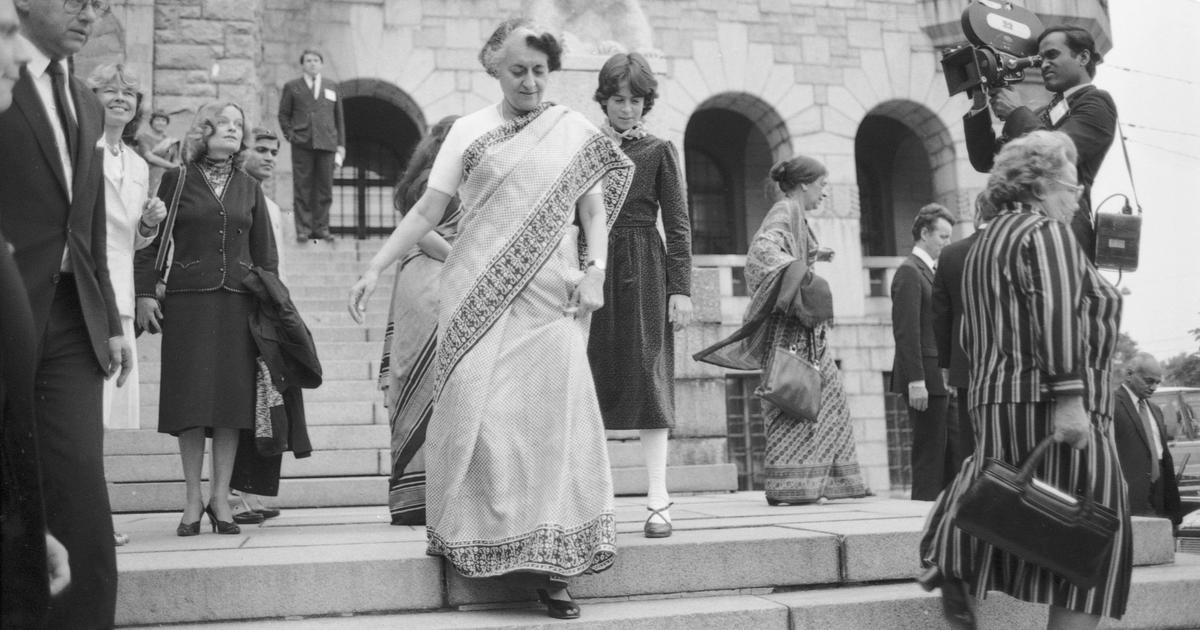
In October 1968, two years after Venezuela opened one of its first embassies in Asia in New Delhi, Indian Prime Minister Indira Gandhi visited the resource-rich South American nation. The 18-hour visit was the penultimate leg of a Latin America tour that covered Brazil, Chile, Argentina, Uruguay, Colombia and Trinidad, among other countries.
From the outset, Caracas rolled out the red carpet for Gandhi. At Simon Bolívar Maiquetia Airport, she was greeted by an unusually large delegation that included the Venezuelan president and vice-president, the chief justice of the Supreme Court, the attorney general, cabinet ministers and members of the clergy.
“Her arrival was marked by festivity, warmth and hospitality, solidarity and applause,” Venezuelan academic Hernan Lucena Molero wrote in a 2013 paper titled Indira Gandhi in Venezuela (1968-2013): 45th Anniversary of a Historic Visit. “Security was provided by female personnel deputed by the Venezuelan state; flags from both countries lined the runway and many journalists intent on doing their job, unmindful of the pushing and shoving by the military police, covered the event.”
Breaking protocol, Gandhi asked Venezuelan President Raul Leoni to let her accept bouquets from locals and Indian expatriate children. “The airport was filled, thanks to a significant turnout by the Venezuelan public,” Molero wrote. “The people of Venezuela, who found inspiration in India’s struggle for independence, did not hold back in expressing their affection for her leader.”
Gandhi reciprocated the warmth at a banquet hosted by Leoni, highlighting the two countries’ shared anti-colonial histories: “This is my first visit to Venezuela but during our freedom struggle, we drew inspiration from other similar struggles against colonial empires,” she said. “The names of Francisco Miranda, Simon Bolivar, [Jose Antonio] Paez, the first president of Venezuela are part of the history of human freedom.”
Gandhi’s brief visit caught the attention of the South American nation. “Images of this lady of imposing stature, in a traditional green coloured sari with black checks, shot with golden threads, a simple string of pearls and a watch, her only accessories, were beamed simultaneously into thousands of Venezuelan homes by the National Television Channel OCI,” Molero wrote.
A joint communique pledged expanded cooperation in “commercial, cultural, technological and scientific fields”. “I come to build bridges of love between Latin America and my country,” Gandhi said in Caracas.

To Molero, Gandhi’s words “clearly demonstrated the political will of the Asian leader and showed the path that Venezuela and the rest of the region would have to take in the Cold War era, with complete clarity on a) the concepts of integration and firm friendship and b) working together to find a firm solution to and long term issues: initiating the process for drafting of work plans and joint programs that would help in the achievement of the development goals of both parties”.
Before leaving Venezuela, Gandhi held an hour-long press conference at the Tamanaco Hotel, where 13 journalists posed what Molero described as “polemic” questions about India. These ranged from food shortages and birth control to beef consumption and the generous pensions paid to former royals.
Coming months after India opened a resident mission in Caracas, Gandhi’s visit built on a carefully cultivated diplomatic relationship – one that would prove particularly valuable just three years later, during a major humanitarian crisis in what was then East Pakistan.
Common cause
Despite the distance, both India and Pakistan actively sought support in South America during the Bangladesh Liberation War. Most countries disregarded the appeals, choosing to stay neutral. Not Venezuela.
A 1979 report by the Historical Division of India’s Ministry of External Affairs noted that Venezuela emerged as one of India’s strongest supporters in Latin America during and after the conflict.
“During the Bangladesh and Pakistan crisis of 1971, Venezuela’s public opinion was sympathetic towards India’s stand,” the report said. “Venezuelan National Congress, on its own initiative, passed a resolution endorsing India’s stand and giving support to the people of Bangladesh.”
As the Bangladesh cause resonated with the Venezuelan public, their government became more diplomatically proactive. “Venezuela also took the initiative at the Latin American Parliament to have a unanimous resolution adopted on this question,” the report said. “Venezuela was the second country in Latin America, after Cuba, to recognise Bangladesh, in May 1972.”
Cooperation between New Delhi and Caracas extended to global issues where both shared common positions, including opposition to apartheid in South Africa and South Africa’s occupation of Namibia.
“On Africa, Venezuela’s views are also identical to those of India,” the report said. “Venezuela has expressed support to the people of Africa who are struggling for freedom.”
At the United Nations General Assembly, both countries condemned the apartheid regime for the Cassinga massacre, in which South African forces killed 600 Namibian refugees, including 300 children, in 1978.
“Venezuela, like India, has been condemning in the General Assembly of the U.N., South African policy in Namibia,” the report noted. “The resistance of South Africa, the centre for every policy of racial discrimination and violence in Africa and its refusal to implement the Security Council’s resolution, have deeply caused concern to the government of Venezuela.”
Venezuela’s leadership also expressed appreciation for India’s foreign policy during the 1970s. When accepting the credentials of the Indian ambassador in 1978, President Carlos Andres Perez remarked on India’s efforts to address complex global challenges.
“In spite of geographical distances, the President said the two countries were one in spirit, particularly in their foreign policy,” the report said. “He also referred to Super Powers attempts at affecting the decisions of developing countries and sounded a note of caution against their designs.”
Another area of convergence in the 1960s and 1970s was disarmament. Venezuela, the report said, was keen to participate in multilateral disarmament conferences and expressed concern over the proliferation of conventional weapons. Such proliferation “unjustifiably diverts vital resources from development and removes opportunities for people to live lives of dignity in keeping with the right to economic and social well being,” it said.
Safe distance
While Indian political and business delegations regularly visited Venezuela in the 1970s, fewer than 100 Indians lived in the country. This small community – comprising mainly businessmen, teachers, missionaries and a handful of government consultants – was viewed favourably by locals.
By 1977, the Missionaries of Charity had established six centres across Venezuela, staffed by 20 Indian nuns. That year, Mother Teresa undertook a 10-day visit to the country that was also home to a small number of Indian Catholic priests.
Around the same time, 60 Indian engineers helped set up a major steel plant in the industrial port city of Puerto Ordaz in Bolivar state. It was also in the mid-1970s that a few Indians explored opportunities in Venezuela’s oil industry. Their numbers never grew significantly, as falling oil prices, capital flight and currency devaluation made the country less attractive.
Diplomatic engagement continued in later decades, with President Hugo Chavez visiting India in 2005 and his foreign minister, Nicolas Maduro, who would later be his successor, visiting in 2012.
When Maduro was abducted and renditioned by the United States, India’s official response – describing the developments in Venezuela as “a matter of deep concern” without explicitly naming or condemning Washington – stood in contrast to the 1970s, when New Delhi and Caracas stood firmly together against the heavy-handedness of the superpowers of the day.
Ajay Kamalakaran is a writer, primarily based in Mumbai. His Twitter handle is @ajaykamalakaran.
